How Much Does It Cost to Rent in Osaka? A Realistic Guide for Foreign Residents
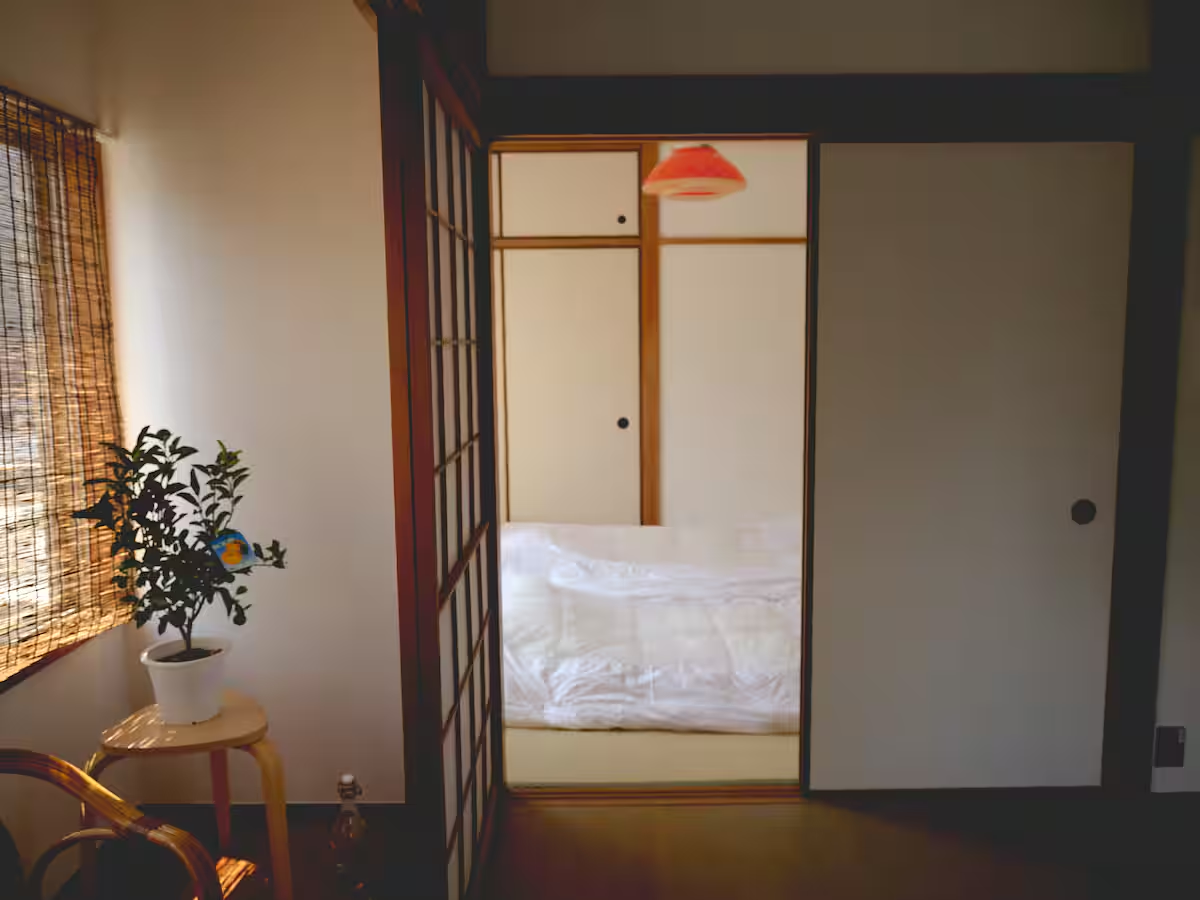

Osaka has a reputation as one of Japan's more affordable major cities — and in many respects, that reputation is earned. Compared to Tokyo, rental prices in Osaka are genuinely lower, sometimes significantly so. But "more affordable than Tokyo" is not the same as "cheap," and the number that appears on a listing is not the number that appears on your bank statement in the first month.
This article gives you an honest, current picture of what renting in Osaka actually costs — not just the monthly rent, but the full upfront payment, the ongoing monthly charges, and the costs that accumulate over the course of a standard two-year tenancy. It covers the full range of the market: from compact studio apartments at the budget end to spacious family apartments and premium units for those with higher budgets or more demanding requirements. And it explains where the numbers diverge from expectations — which, for foreign renters in Osaka, is more often than most guides suggest.
IN THIS ARTICLE
Osaka's rental market covers an enormous range — from compact 1K studios in outer residential wards at ¥40,000 per month to premium tower apartments in Chuo Ward at ¥400,000 and above. Most foreign renters land somewhere in the middle of that range, and understanding the price bands by apartment type is the starting point for any realistic budget conversation.
The entry level of Osaka's rental market. A 1R (single room, no separate kitchen) or 1K (single room with a small separate kitchen space) in a residential ward outside the city center — Hirano, Higashinari, parts of Sumiyoshi — starts from around ¥40,000–¥55,000 per month. The same apartment type in a more central or foreigner-accessible area — Namba, Shinsaibashi, Tennoji, Fukushima — typically runs ¥60,000–¥85,000. At the top of this category, a newer or renovated 1K in a central location can reach ¥90,000–¥110,000.
For the difference between 1R, 1K, 1DK, and 1LDK apartment types, our dedicated guide to Japanese apartment size categoriesexplains the Japanese naming convention in full.
The most popular category among foreign renters who want a genuine separation between living and sleeping spaces. In accessible central neighborhoods, 1LDK apartments typically range from ¥85,000 to ¥140,000 per month depending on age, condition, floor level, and building quality. Newer buildings with modern finishes at mid-floor levels in areas like Honmachi, Kitahama, or Namba push toward the upper end of that range. Older but well-maintained stock in slightly less central areas sits in the ¥85,000–¥110,000 range.
The standard for couples, small families, or professionals who want a dedicated workspace. Central Osaka 2LDK apartments in newer buildings run ¥130,000–¥200,000 per month. In more residential wards — Fukushima, Nishi Ward, parts of Tennoji — the same money buys more space. At ¥150,000–¥170,000 in these areas, a well-located 2LDK in a quality building is achievable.
Family-sized apartments in Osaka at genuine quality start from around ¥180,000 in residential wards and rise to ¥300,000+ for premium central locations, high-floor tower units, or properties in buildings with strong management and amenities. The supply of large, high-quality family apartments accessible to foreign tenants is more limited than for smaller units, and this segment benefits most from working with an agent who knows where the stock is.
Osaka has a meaningful premium rental market centered on its tower mansions — high-rise condominium buildings with panoramic city views, concierge services, and full building amenities. Monthly rents in this segment start from around ¥200,000 for a 1LDK on a high floor and rise to ¥500,000+ for large, premium units in the best buildings. For foreign renters looking at the top of the market, our article on tower mansions in Osaka covers this segment in detail.
The single biggest financial surprise for foreign renters in Japan — and the one most responsible for the gap between budget expectation and reality — is the upfront cost of moving in. In many Western rental markets, moving in requires first month's rent and a deposit. In Japan, the first payment is typically a multiple of the monthly rent, and it arrives all at once.
The composition of upfront costs has evolved significantly over the past decade, particularly in Osaka, where the traditional reikin (key money, a non-refundable payment to the landlord) has declined substantially. Many Osaka landlords no longer charge reikin, and the traditional shikikin (security deposit of two months' rent) has also been reduced or eliminated in many properties. But even in its leaner modern form, Osaka's upfront rental cost structure requires careful budgeting.
For a standard Osaka rental at ¥100,000 per month, a realistic upfront payment range looks like this:
Adding these up for a ¥100,000/month apartment, the total upfront payment in a typical Osaka rental scenario runs from approximately ¥385,000 (minimal deposits, no reikin) to ¥660,000 (full deposits plus reikin). The midpoint — around ¥450,000–¥500,000 for a ¥100,000/month apartment — is a reasonable working figure for budget planning.
As a rule of thumb: budget four to five months' rent as your upfront moving-in cost and you will not be surprised. For a full breakdown of each cost component and how they are calculated, our article on initial costs when moving in Japan covers every line item in detail.
The monthly rent figure on a listing is not your monthly housing cost. It is your base rent. Several additional charges apply every month, and understanding them in advance prevents the kind of cash flow surprise that hits renters in their first month.
Most apartments in professionally managed buildings charge a monthly management fee in addition to rent. This covers the cost of building upkeep — cleaning of communal areas, maintenance of lifts and common systems, building staff where applicable. In standard residential buildings, this fee typically runs ¥3,000–¥10,000 per month. In premium tower buildings with more comprehensive services, it can reach ¥20,000–¥40,000. This fee is almost always listed separately from the rent on Japanese property portals — it is the kanrihi figure next to the rent figure.
If you have or plan to have a car in Osaka, parking is a significant additional cost. Central Osaka parking rents from ¥20,000 to ¥50,000+ per month depending on location. In most central apartments, parking is not included in the rent — it is a separate contract. For renters without cars, this is irrelevant. For those with cars, it is a substantial additional line item.
Osaka's utility costs for a typical one-bedroom apartment run approximately ¥15,000–¥25,000 per month combined for electricity, gas, and water. Air conditioning usage in Osaka's hot, humid summers pushes electricity bills up significantly — a 1LDK with heavy summer cooling use can see monthly electricity bills of ¥8,000–¥15,000 in July and August alone. Winter gas bills for heating and hot water add a similar seasonal spike. Budgeting ¥20,000–¥25,000 per month for utilities in a standard apartment is prudent.
Japan's internet infrastructure is excellent, and connection costs are reasonable. A fiber connection with speeds suitable for streaming and remote work typically runs ¥4,000–¥6,000 per month. Some buildings offer building-wide fiber included in the management fee — this is worth checking when evaluating apartments, as it represents meaningful ongoing savings.
Beyond the initial guarantor company fee paid at move-in, many guarantor companies charge an annual renewal fee — typically ¥10,000–¥20,000 per year — for the continuation of the guarantee. This is easy to miss in initial budget planning but is a real recurring cost for the duration of the tenancy.
For foreign renters who have researched the Tokyo market before considering Osaka, the price comparison is one of the most striking aspects of the Osaka decision. The differential is real and meaningful — not marginal.
A 1LDK apartment in a central, accessible Tokyo ward — Shinjuku, Shibuya, Minato — at equivalent quality to a central Osaka 1LDK typically rents for ¥150,000–¥220,000 per month. The equivalent in Osaka runs ¥85,000–¥140,000. The gap compounds: upfront costs in Tokyo are also higher on average, because reikin persists more strongly in Tokyo's rental market than in Osaka's, and deposit levels are typically higher.
Over a two-year tenancy, the difference between renting a comparable apartment in central Tokyo versus central Osaka can easily represent ¥1,000,000–¥2,000,000 in total housing expenditure. For foreign renters whose work is location-flexible — remote workers, self-employed professionals, entrepreneurs — the Osaka cost advantage is a material factor in the decision.
For a broader comparison of the two cities across investment and lifestyle dimensions, our Osaka vs Tokyo real estate guidecovers the full picture.
Here is something that most rental cost guides don't address directly: foreign renters in Japan often pay a premium relative to domestic renters — not because landlords explicitly charge them more, but because the market dynamics of the foreign-accessible segment push prices upward in specific ways.
The supply of apartments that genuinely accept foreign tenants — with foreign-friendly management companies, guarantor companies that approve non-permanent residents, and landlords comfortable with non-Japanese communication — is a subset of total market supply. Foreign renters are competing within a smaller pool of available properties, and that constraint affects price. The most accessible, best-positioned foreigner-friendly apartments in central Osaka command a premium precisely because demand for them from the foreign tenant community is disproportionately concentrated.
Additionally, furnished apartments and monthly mansion properties — which many foreign renters use as an entry point before transitioning to a standard lease — carry a significant per-square-metre premium over equivalent unfurnished stock. A furnished 1LDK in central Osaka at ¥130,000–¥180,000 per month may represent a similar physical space to an unfurnished 1LDK at ¥95,000 — but the furnished premium is real and reflects the convenience of not needing to acquire furniture in Japan.
The practical implication: a foreign renter who can access the broader rental market — not just the explicitly foreigner-marketed segment — gets more for their money. This is where an agent with genuine market reach makes a concrete financial difference, not just a process difference. Our article on foreigner-friendly apartments in Osaka explains how to navigate the broader market as a foreign tenant.
Osaka's rental market has meaningful geographic price variation, and understanding the ward-by-ward landscape helps foreign renters make location decisions that reflect both their lifestyle priorities and their budget constraints.
Chuo Ward — covering Namba, Shinsaibashi, Honmachi, and Kitahama — and Kita Ward — covering Umeda and the areas around Osaka Station — represent the top of the residential rental market. Central location, excellent transport, proximity to Osaka's commercial and cultural core. A 1LDK in these wards in a quality building rarely goes below ¥100,000 and more typically sits at ¥120,000–¥180,000 for anything worth renting. For our neighborhood guides to these areas, see our articles on Namba and Umeda.
These wards offer central convenience at meaningfully lower prices than Chuo and Kita. Fukushima Ward — with its riverside character, proximity to Umeda, and growing stock of newer apartments — is one of the best value propositions in Osaka's central market for foreign renters. A 1LDK in a newer Fukushima building typically runs ¥85,000–¥120,000. Tennoji, anchored by its park and JR/subway interchange, offers similar value with a different character. Nishi Ward offers proximity to Namba and a quieter residential texture. Our guides to Fukushima, Tennoji, and Nishi Ward cover each area in depth.
Osaka's outer and traditionally working-class wards offer the lowest rental prices in the city. A 1K in Higashinari or Hirano can be found below ¥50,000. Nishinari Ward is the cheapest ward in Osaka by median rent but comes with specific character and considerations that aren't for everyone — our article on Osaka wards and their realities addresses this honestly.
For foreign renters on genuine budget constraints, these outer wards deserve serious consideration — particularly for those whose work allows flexibility on commute. The subway network means that a well-chosen apartment in a residential outer ward can be 20 minutes from central Osaka at half the central price.
For an overview of where foreign residents typically concentrate in Osaka and why, our guide to where foreigners live in Osakacovers the community geography in detail.
Pulling these numbers together into a total cost of a standard two-year tenancy puts the full financial picture in perspective. Using a ¥100,000/month apartment in a central-to-mid-market Osaka location as the reference point:
Total two-year housing cost: approximately ¥3,750,000–¥3,900,000 — or roughly ¥156,000–¥163,000 per month on an all-in basis, against a headline rent of ¥100,000.
This is the number that matters for budget planning — not the listing rent. The gap between headline rent and true housing cost is approximately 55–65% in a standard Osaka tenancy. For renters used to markets where the listed rent is close to the all-in cost, this recalibration is important.
Understanding the cost structure is useful. Knowing how to navigate it strategically is more useful. Several approaches consistently help foreign renters in Osaka get better value for their housing budget.
Osaka's rental market has moved significantly away from the reikin model, but not uniformly. Newer buildings, larger management companies, and properties that have been vacant for a period are all more likely to have zero reikin and reduced deposit terms. The listings that still carry reikin are often older properties managed by traditional landlords who haven't updated their cost structure to reflect current market norms. Avoiding these properties reduces your upfront cost by a full month's rent.
The areas that foreign renters search most heavily — Namba, Shinsaibashi, immediate Umeda vicinity — are priced to reflect that concentration of demand. Moving the search perimeter by one or two subway stops can produce meaningfully different prices for equivalent apartments. Sakaisuji Honmachi, Awaza, Higobashi — these are central, well-connected locations that don't carry the Namba or Shinsaibashi premium.
As noted above, the explicit foreigner market is a premium subset. Renters who can access the broader market — with the right agent and the right application preparation — get more for their money. This is one of the most consistent ways that working with a specialist broker produces a financial return, not just a process benefit.
Japan's rental market has a distinct seasonal pattern. The March–April period — driven by Japan's academic and corporate year transition — is peak season, with higher prices, more competition, and less negotiating room. The September–October and November–December periods are softer, with more available inventory and landlords more willing to discuss terms. If your timeline is flexible, searching outside peak season consistently produces better outcomes.
For more on how to approach the search itself, our guides to searching for property in Japan and the essential steps to renting in Japan provide practical context for the full process.
The rental market in Osaka is deep and genuinely accessible to foreign residents — but navigating it efficiently, with accurate information about what your budget realistically achieves and where the best value actually sits, requires more than a portal search and a willingness to apply.
At Maido Estate, we work with foreign renters across the full budget range — from first arrivals looking for a clean, central 1K at ¥70,000 to professionals and families looking for quality 2LDK and 3LDK apartments at ¥150,000–¥250,000. We know which areas offer the best value at each price point, which buildings have genuinely moved away from reikin and deposit structures, which management companies work smoothly with foreign applicants, and how to present your profile to maximize your chances with landlords who might otherwise hesitate.
We operate in English, French, and Japanese, which means the search, the application, and the negotiation all happen at full quality — without translation gaps or missed nuances that affect outcomes.
If you want a clear picture of what your budget achieves in the current Osaka market — which neighborhoods, which apartment types, which trade-offs — that conversation takes twenty minutes and costs nothing. Use our Room Finder to start the process, or contact us directly.
Renting in Osaka as a foreigner is entirely achievable across a wide range of budgets. The key numbers to carry from this article:
Osaka rewards renters who go in with accurate information and realistic expectations. The city offers genuine quality of life at prices that comparable global cities can't match — provided you understand what the full cost picture looks like before you start.


